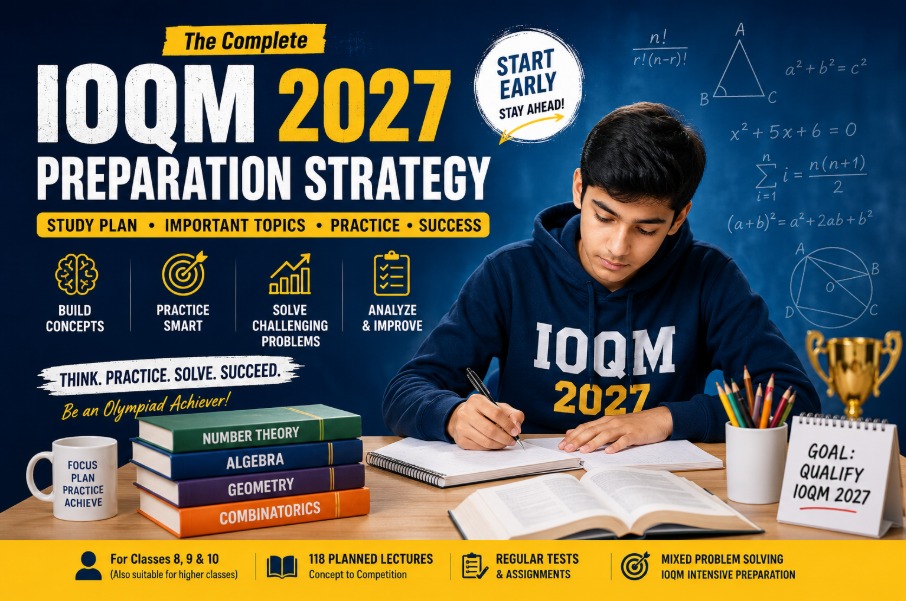
IOQM 2027 Preparation: The Complete Strategy to Start Early and Prepare Smart
Are you a Class 8, 9, 10, 11 or 12 student dreaming of becoming stronger at Mathematics—not just scoring marks, but actually solving challenging mathematical problems?
Then the Indian Olympiad Qualifier in Mathematics (IOQM) can be an excellent challenge to take up.
But there is one important thing students should understand:
IOQM preparation is not about memorising more formulas. It is about learning how to think mathematically.
The official Mathematical Olympiad programme identifies algebra, combinatorics, geometry and number theory as major areas of Olympiad mathematics, with the difficulty increasing in the later stages.
That is why starting your preparation early can make a huge difference.
What is IOQM?
IOQM stands for Indian Olympiad Qualifier in Mathematics. It is the first-stage examination in India's Mathematical Olympiad programme. The programme is organised through the national Olympiad system led by Homi Bhabha Centre for Science Education (HBCSE).
IOQM is different from a normal school examination.
In school mathematics, students are often asked:
"Which formula should I use?"
In Olympiad mathematics, the more important question is:
"How can I solve this problem?"
You may know every formula in your textbook and still struggle with an Olympiad problem.
And that is exactly what makes Olympiad mathematics interesting.
Why Should Students Start IOQM 2027 Preparation Early?
One of the biggest mistakes students make is starting Olympiad preparation only a few weeks before the examination.
IOQM preparation requires three things:
1. Strong Mathematical Fundamentals
Students need to be comfortable with school-level mathematics before moving toward advanced problems.
2. Exposure to Different Problem-Solving Techniques
Knowing a concept is not enough. Students must learn how that concept can be used in unfamiliar situations.
3. Consistent Practice
Mathematical problem-solving ability develops gradually.
You cannot become an Olympiad problem solver by watching 20 lectures in one month.
You need to learn → attempt → struggle → make mistakes → analyse → try again.
That process takes time.
IOQM Preparation Is More Than Just a Syllabus
The official HBCSE syllabus guidance states that aspirants should be familiar with mathematics covered in the relevant NCERT classes and highlights the importance of major areas such as algebra, combinatorics, geometry and number theory.
But completing a chapter is only the beginning.
For example, a student may know:
But an Olympiad problem may combine two or three of these ideas in a completely unfamiliar configuration.
Therefore, your preparation should have two layers:
Layer 1 — Concept Building
Learn the mathematics.
Layer 2 — Problem Solving
Learn how to use the mathematics.
IOQM 2027 Preparation Strategy
A good long-term preparation plan can be divided into several phases.
Phase 1: Build the Foundation
Start with important mathematical tools:
The objective at this stage is not to solve the hardest problems.
The objective is to become comfortable with mathematics.
Phase 2: Master Number Theory
Number Theory is one of the most important areas of Olympiad mathematics.
Students should gradually learn:
Don't simply study these as definitions.
Ask:
"What kind of problems can this concept help me solve?"
That question changes the way you learn mathematics.
Phase 3: Build Strong Algebra
Algebra is another major component of Olympiad preparation.
Important areas include:
The goal should be to move from:
Formula → Application → Strategy → Problem Solving
rather than simply completing exercises.
Phase 4: Give Geometry Serious Attention
Many students become uncomfortable when they see a complicated geometry diagram.
The solution?
Practice geometry regularly.
Build your preparation around:
The most important geometry skill is not memorising theorems.
It is learning to ask:
"What construction or relationship am I missing?"
Phase 5: Learn Combinatorial Thinking
Combinatorics teaches students to think systematically.
Important topics include:
Combinatorics is particularly useful for developing creative problem-solving skills.
Phase 6: Mixed Problem Solving
This is where preparation becomes much more interesting.
Once students have studied individual topics, they should stop thinking:
"Today's chapter is Number Theory, so the answer must use Number Theory."
Instead, they should see a problem and ask:
"Which mathematical idea can unlock this problem?"
A problem might require:
Number Theory + Algebra
or
Geometry + Combinatorics
or
Algebra + Inequality
or even several ideas together.
This is why a dedicated mixed-problem-solving phase is extremely valuable.
Phase 7: IOQM Intensive Preparation
The final stage should focus on exam-oriented preparation.
Students should work on:
HBCSE also provides previous Mathematical Olympiad question papers and solutions as preparation resources.
The final objective is not simply:
"I have studied the syllabus."
It should be:
"I can solve unfamiliar problems under time pressure."
How Many Hours Should a Student Study for IOQM?
There is no single perfect number of hours for every student.
A better approach is to maintain consistent weekly practice.
For a school student, a practical routine could be:
On Class Days
60–90 minutes
On Non-Class Days
45–60 minutes
Weekend
Spend additional time on:
A timed problem set or mock test.
The quality of practice matters more than simply counting hours.
The Golden Rule of Olympiad Preparation
Don't look at the solution too quickly.
Suppose a problem takes you 30 minutes.
You don't know how to solve it.
That does not automatically mean you should see the solution.
Try:
20 minutes → think again → change approach → draw another diagram → test a smaller case → look for a pattern.
Sometimes the most valuable part of Olympiad preparation is the struggle before the solution.
Maintain an "Olympiad Mistake Book"
This is one of the simplest and most effective habits a student can develop.
Whenever you make a mistake, record:
Problem → My Approach → Mistake → Correct Idea → What I Learned
For example:
Mistake: I assumed a property without proving it.
Lesson: Never assume a diagram is accurate. Use mathematical relationships.
After several months, this notebook becomes a personal collection of your weak areas and problem-solving lessons.
How Many Problems Should You Solve?
Don't chase a huge number of random questions.
Instead, focus on quality problems.
A useful weekly target can include:
Level 1
Concept-building problems
Level 2
IOQM-level problems
Level 3
Challenging Olympiad problems
The objective is to gradually increase difficulty.
Previous-Year Papers Are Extremely Important
Previous-year papers help students understand:
Don't use previous papers only at the end.
Use them throughout preparation.
First solve individual questions.
Later solve complete papers under timed conditions.
What Parents Should Understand About IOQM Preparation
Parents often ask:
"My child is getting 95% in school Mathematics. Will IOQM be easy?"
Not necessarily.
School marks and Olympiad performance measure different skills.
A student can be excellent at routine mathematics but initially struggle with Olympiad problems.
That is normal.
Olympiad preparation is a skill-development journey.
The right question is not:
"How many questions did my child solve today?"
Instead ask:
"What new problem-solving idea did my child learn today?"
TPLIVE IOQM 2027 Preparation Program
At TPLIVE Kota, our IOQM 2027 program is designed as a long-term mathematical problem-solving journey.
The planned program includes:
118 Live Lectures
83 Core Mathematics Lectures
The course covers:
The detailed lecture plan is structured to gradually move students from concept building to advanced problem solving.
A Simple 5-Step Formula for IOQM 2027
Remember this:
1. Learn
Understand the concept.
2. Practice
Solve basic and intermediate problems.
3. Struggle
Attempt difficult problems without immediately seeing the solution.
4. Analyse
Understand why your approach worked or failed.
5. Repeat
Solve more problems and build mathematical intuition.
That's how mathematical thinking develops.
Final Advice for IOQM 2027 Aspirants
If you are planning to appear for IOQM 2027, don't wait until the examination is near to start serious preparation.
Start building your mathematical foundation early.
You don't need to solve every difficult problem on Day 1.
You simply need to become 1% better at mathematical problem solving every day.
Because Olympiad mathematics is not a race to memorise formulas.
It is a journey to learn how to think, experiment, reason and solve.
Ready to Start Your IOQM 2027 Journey?
TPLIVE Kota – IOQM 2027 Mathematics Olympiad Program
📚 118 Planned Live Lectures
🧠 Concept + Problem Solving
🎯 Mixed Olympiad Problem Practice
📝 Regular Tests & Assignments
🔥 Dedicated IOQM Intensive Phase
Batch Starting: 10 September 2026
Visit: www.tplivekota.com
Contact: +91-8306581833
TPLIVE KOTA | Learn. Practice. Live Success.
Don't just learn Mathematics. Learn to think like a Mathematician.
Did you come here for something in particular or just general fiber-bashing? And blowing into
New Posts
Total Visitors
New Subscribers
Blog Read